Yes, What?
The Classroom at the Center of It All
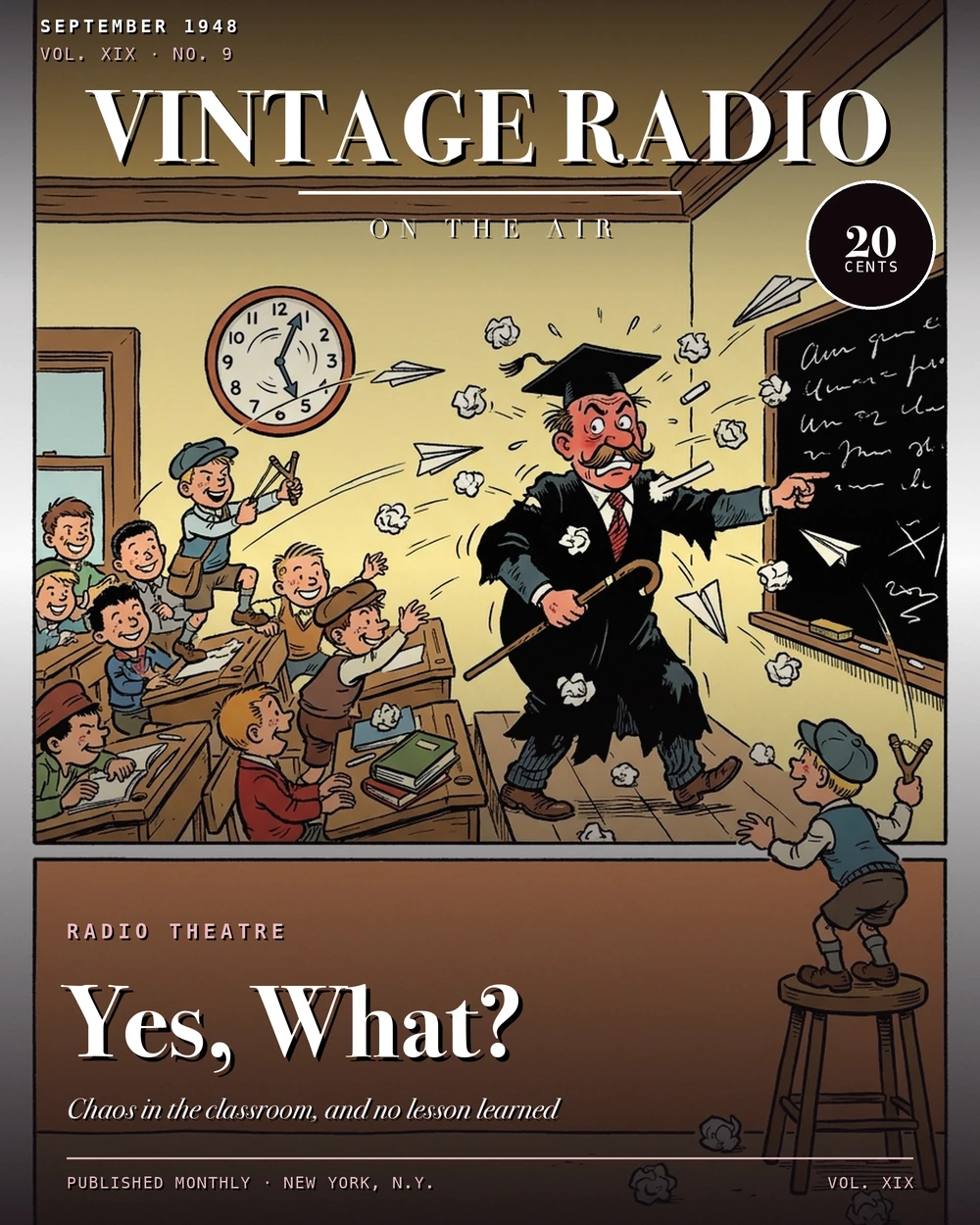
Yes, What? built its entire world inside a single room. Nearly every episode took place in a school classroom, where a group of students devoted themselves to one shared purpose: keeping their schoolmaster, Dr. Percival Pym, from teaching a single lesson. That was the whole engine of the show — and for well over 500 episodes, it never stopped running.
The students went about it every way imaginable. Nonsensical questions, implausible personal tales, deliberate tardiness, and general rowdiness all served the cause. The more they interrupted, the more Dr. Pym lost control, until he was shouting and, on occasion, reaching for the cane. Corporal punishment was presented as an accepted part of school life at the time, and Dr. Pym's escalating exasperation was played for laughs rather than drama. The formula sounds simple — and it was — but the timing, the characters, and the sheer commitment of the cast carried it across a remarkable run.
The show's very title came out of this dynamic. Certain students, particularly Greenbottle and Mr. Snootles, had a habit of saying "yes" even when they mean "no" — a reflexive affirmation that preceded whatever chaos they were about to introduce. Dr. Pym's weary, increasingly frantic response — "Yes, what?" — became his catchphrase and eventually the show's name.
How It Got Started
Yes, What? began on 23 June 1936, airing at 9:15 pm on Adelaide radio station 5AD. It had a different name then — The Fourth Form at St. Percy's — before studio executives decided that title was too long and pushed for a change. The concept had been pitched to Rex Dawe by Rex Heading, and the show was loosely based on the British radio serial The Fourth Form at St. Michael's by Will Hay, which had aired in the 1920s.
Dawe was just 24 years old when the series launched, and he wore essentially every hat on the production. He wrote it, produced it, directed it, and performed the lead role of Dr. Pym himself. He had been trained as a lawyer — actually admitted to the bar — before abandoning the profession for broadcasting. His inspiration for the show drew directly from personal experience: eight years as a boarder at Prince Alfred College had given him plenty of material to work with.
The budget 5AD program manager Morrie Chapman allocated for the show was fifty shillings, plus an additional ten for the writer and producer. The original cast was drawn from The Kangaroo Club, a young people's production ensemble, which meant Dawe was working with genuine youth — fifteen-year-old Ralph Peterson was hired to play Rupert Bottomly, and Jim Williams, who played Ronald George Stanforth, joined the cast at fourteen. Episodes ran about twelve minutes each and aired twice a week, mostly on Tuesday and Thursday nights.
The Characters Who Made It Work
The student roster had a distinct personality for each role, and the characters evolved considerably over the show's run. Greenbottle — full name Cuthbert Horace Greenbottle, Jr. — was played by Jack Craig-Gardiner, born in 1915. In the early episodes, Greenbottle was played as an old-man type rather than the high-pitched, falsetto-voiced character audiences eventually came to expect. Those earlier episodes were later considered less sharp, and it was the evolved, faster-paced version of the show that became the standard for broadcast.
Greenbottle's signature move was arriving late with some wildly implausible excuse, then proceeding to derail whatever lesson Dr. Pym had been attempting. When Craig-Gardiner's health made his continued involvement uncertain, the production adapted by creating a new character — Francis Marmaduke Algernon de Pledge, played by Richard Harding-Browne — who joined in episode 344, with Greenbottle temporarily written out two episodes earlier. Greenbottle returned in episode 394, and for a stretch the show ran with four students in the classroom. De Pledge departed in episode 437, when Harding-Browne left to join the air force.
Rounding out the cast were Frank McCarron as Mr. Basil Cornelius Snootles and Alice Creed as Daphne. The full character names across the ensemble — Rupert Bottomly, Ronald George Stanforth, Francis Marmaduke Algernon de Pledge — carried a particular kind of British comedic absurdity that fit the schoolroom setting perfectly. Episode titles from the surviving run give a sense of the territory: School Fire Parts 1 and 2, Looking For An Escaped Lunatic, Bottomly Arranges Morning Tea, Advertising Eggs, Visit Of The School Inspector, House Of Tudor Exam, The Royal Show, Bottomly Cleans The Blackboard, Mr Snootles Conducts His First Lesson. Whatever the pretext, the room would be in chaos within the first minute.
A Run That Kept Going Long After the Broadcast Ended
Yes, What? ran to 520 episodes total. The first fifty or so went out live to air without being recorded, meaning only a portion of the full run survives on tape. By the time production ended — the National Film and Sound Archive's official registry gives the dates as 1936–40, with the NFSA's own editorial material pointing to December 1940 as the close of original production — the show had broadcast roughly 130 hours of programming and had grown from a local Adelaide curiosity to a nationally broadcast series, reaching that status by 1938.
The broadcast history didn't end there. The recorded episodes were rebroadcast continually for some sixty years afterward. Episodes 209 through 520 became the standard broadcast package, with 300 of those episodes made available through Grace Gibson Productions for commercial station use. The show found audiences beyond Australia as well — it was particularly popular in New Zealand and South Africa. Sony released CD box sets in the 2000s, and Grace Gibson Productions began releasing the broadcast episodes in chronological order in December 2013. As of 2024, eighteen volumes are available: sixteen covering all 312 broadcast episodes, plus two "Missing Episodes" volumes containing 40 surviving episodes from the non-broadcast range.
In 2013, Yes, What? was inducted into the National Film and Sound Archive Sounds of Australia Registry, a recognition that placed it among the recordings considered most significant to Australian cultural heritage.
What Happened After
Rex Dawe didn't walk away from Dr. Pym easily. After the original run ended, he attempted a revival under the title Dr. Pym's Progress, but the effort failed both critically and commercially. The character that had worked so perfectly in the schoolroom apparently didn't translate to a new setting.
Dawe's career took other directions. He became a regular comic performer for the Colgate shows, and eventually moved to Spain in the 1950s. He died there on 8 October 1972, at the age of 60. The show he had built at 24, on a sixty-shilling budget, with a cast of teenagers pulled from a youth ensemble, had outlasted his own efforts to follow it up and was still being broadcast in new markets decades after he'd moved on.
One other artifact survived from the show's cultural reach: in 1947, a colored Yes, What? cartoon book illustrated by Emile Mercier was published by the program's then-sponsor on Sydney station 2CH — the Samuel Taylor chemical company, which made the Australian insecticide Mortein. The show had accumulated enough of an audience by that point that its characters were worth putting in a cartoon book and attaching to a brand. For a twelve-minute radio comedy about a hapless schoolmaster and a classroom full of troublemakers, that was a long way from Adelaide at 9:15 on a Tuesday night in 1936.